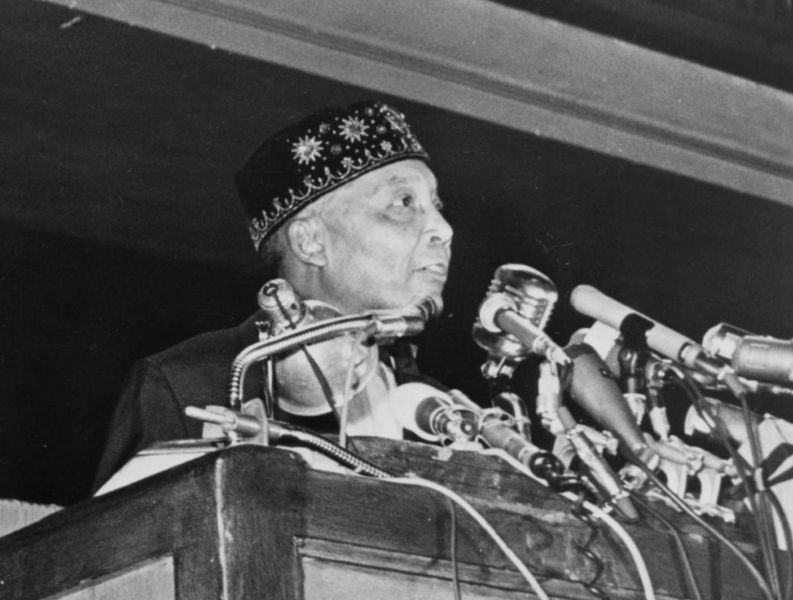
Moses Fleetwood Walker

بسم الله الرحمن الرحيم

Image result for moses walker

As-Salaamu ‘Alaikum Beloved Brothers & Sisters

If I may, I would like to introduce you to a personage from American Black History with whom you may or may not be familiar.

Most people erroneously credit Jackie Robinson with being the first Black person to break the color barrier in major league baseball. Few people know of Moses Fleetwood Walker who, according to MLB.com, was the “first African-American to play in Major Leagues.”

However, even fewer people know of Walker’s dedication to the struggle for equal rights among Black people.

Walker penned a treatise in 1908, wherein he stated, “The only solution to America’s race problem is the entire separation by emigration of the Negro from America.”

You know this sounds like it came from the mouth of Our Beloved Messenger, The Honourable Elijah Muhammad (May the Peace and the Blessings of Allah Forever Be Upon Him).

So, I found the treatise. You can read it in its entirety and for free by clicking the following link.

“Our Home Colony: A Treatise On The Past, Present And Future Of The Negro From America”

WHY THEY DON’T TEACH CURSIVE ANYMORE

image.pngبسم الله الرحمن الرحيم

As-Salaamu ‘Alaikum My Beautiful And Beloved Asiatic Black Brothers & Sisters

A few years ago someone told me that a college professor told them that his students couldn’t read handwriting in cursive. She said that when the students saw cursive handwriting they asked, “What is that?

This shocked me, but I didn’t really believe it until my son told me recently that he is the ONLY person in his whole school (High School) who can write in cursive. He’s known for it around campus. I homeschooled him and made sure that his handwriting was beautiful and perfect.

In The Holy Nation of Islam, penmanship is crucial as it is one of the most important means of communicating our thoughts and IDEAS.

Whenever an important business transaction takes place, it is made official by SIGNING YOUR NAME.

I knew the devil taking cursive handwriting out of schools was detrimental but I didn’t realize how much so until yesterday when I was debating with a Brother on Facebook.

He reminded me that to join the Holy Nation of Islam, one is required to write a letter in PERFECT penmanship. And if it is not PERFECT the letter is rejected and membership is denied.

By the devil removing cursive handwriting from his schools, he is imposing yet another obstacle in front of our children towards their progress and ultimate success.

I am still surprised at the magnitude of their evil and I know them better than anyone.

PLEASE, PLEASE, PLEASE BROTHERS AND SISTERS, THE JOB IS ON US NOW, TAKE THE TIME AND ENSURE THAT YOUR CHILDREN KNOW HOW TO READ AND WRITE IN CURSIVE.

I will never forget when I learned how to write in cursive. My teacher spent two weeks just preparing us. We had to spend about fifteen minutes every day just making swirls on the paper. I hated it at the time because I didn’t realize how crucial it was to the beauty of our handwriting. Everyone in my class has compliment-worthy penmanship.

It is worth the time and effort to prepare your children before attempting to teach them how to write in cursive. Have them make connected circles and curvy lines before you actually begin forming letters and words. Like so:

cursive-handwriting-lines-napkin

This will ensure their handwriting is beautiful and more importantly, completely LEGIBLE.

I had no trouble writing my Saviour’s letter and it was only returned because I abbreviated Blvd. But the next time I wrote it, I didn’t include any abbreviations and it passed with flying colors (whatever that means).

Here is a website I found that offers free downloads for cursive tutorials.

http://www.k5learning.com/cursive-writing-worksheets

PLEASE MAKE SURE YOU AND YOUR CHILDREN DEVELOP BEAUTIFUL PENMANSHIP.

IT DOES NOT MATTER IF THEY HAVE ALREADY FINISHED SCHOOL.

MAKE THEM KNOW HOW IMPORTANT IT IS.

* * * *

Benefits of good handwriting include:

  • increased brain activation;
  • improved performance across all academic subjects, especially in language activities such as spelling;
  • providing a strong foundation for higher order skills.

K-12

Bismillah

As-Salaamu ‘Alaikum My Bebies!!!

K12.com is a homeschooling website that gives you the benefit of a quality education for your child away from the distractions and detriments that come with public school.

You can educate your child under your own careful supervision with the same curriculum but at your own pace and on your own schedule.

Take your child out of the devils’ school and away from the devils who only invite them to indecency and filth.

And by all means supplement their curriculum with our own Black History!!!

Ask them if they still give out computers!!!

PAUL LAURENCE DUNBAR

بِسْــــــــــــــــــمِ اﷲِالرَّحْمَنِ اارَّحِيم

We Wear the Mask

We wear the mask that grins and lies,
It hides our cheeks and shades our eyes,—
This debt we pay to human guile;
With torn and bleeding hearts we smile,
And mouth with myriad subtleties.
Why should the world be over-wise,
In counting all our tears and sighs?
Nay, let them only see us, while
       We wear the mask.
We smile, but, O great Christ, our cries
To thee from tortured souls arise.
We sing, but oh the clay is vile
Beneath our feet, and long the mile;
But let the world dream otherwise,
       We wear the mask!
As-Salaamu ‘Alaikum Dearly Beloved Sisters (& Brothers 😉 )
If you have been following my blog, you know that I am very fond of The Harlem Renaissance and as a Black homemaker and homeschooler, we must educate our children on their own history. So, I am going to share with you my studies into The Harlem Renaissance and its “players.”
Being from L.A. and an avid jazz lover, I am particularly proud of the Dunbar Hotel on Central Avenue. So much so, that when I found out about a musical concerning the famous historic site, I went to any means so that I could be a part of the audience.
The musical featured a “Dunbar” character and it really piqued my interest in the man.
I Googled him and learned that he died before the said Harlem Renaissance even began, but he undoubtedly, like the owners of his namesake hotel, influenced many of its writers.

Biography of Paul Laurence Dunbar

Paul Laurence Dunbar poetDunbar was born in Dayton, Ohio to parents who had escaped from slavery; his father was a veteran of the American Civil War, having served in the 55th Massachusetts Infantry Regiment and the 5th Massachusetts Colored Cavalry Regiment. His parents instilled in him a love of learning and history. He was a student at an all-white high school, Dayton Central High School, and he participated actively as a student. During high school, he was both the editor of the school newspaper and class president, as well as the president of the school literary society. Dunbar had also started the first African-American newsletter in Dayton.He wrote his first poem at age 6 and gave his first public recital at age 9. Dunbar’s first published work came in a newspaper put out by his high school friends Wilbur and Orville Wright, who owned a printing plant. The Wright Brothers later invested in the Dayton Tattler, a newspaper aimed at the black community, edited and published by Dunbar.

His first collection of poetry, Oak and Ivy, was published in 1892 and attracted the attention of James Whitcomb Riley, the popular “Hoosier Poet”. Both Riley and Dunbar wrote poems in both standard English and dialect. His second book, Majors and Minors (1895) brought him national fame and the patronage of William Dean Howells, the novelist and critic and editor of Harper’s Weekly. After Howells’ praise, his first two books were combined as Lyrics of Lowly Life and Dunbar started on a career of international literary fame. He moved to Washington, D.C., in the LeDroit Park neighborhood. While in Washington, he attended Howard University.

His wife Alice Dunbar Nelson was a famous poet as well. A graduate of Dillard University in New Orleans, her most famous works include a short story entitled “Violets”. She and her husband also wrote books of poetry as companion pieces. An account of their love, life and marriage was depicted in a play by Kathleen McGhee-Anderson titled Oak and Ivy.

He kept a lifelong friendship with the Wrights, and was also associated with Frederick Douglass and Booker T. Washington. Brand Whitlock was also described as a close friend. He was honored with a ceremonial sword by President Theodore Roosevelt.

He wrote a dozen books of poetry, four books of short stories, five novels, and a play. He also wrote lyrics for In Dahomey – the first musical written and performed entirely by African-Americans to appear on Broadway in 1903; the musical comedy played successfully toured England and America over a period of four years – one of the more successful theatrical productions of its time. His essays and poems were published widely in the leading journals of the day. His work appeared in Harper’s Weekly, the Saturday Evening Post, the Denver Post, Current Literature and a number of other publications. During his life, considerable emphasis was laid on the fact that Dunbar was of pure black descent, with no white ancestors ever.

Dunbar’s work is known for its colorful language and use of dialect, and a conversational tone, with a brilliant rhetorical structure.

Dunbar traveled to England in 1897 to recite his works on the London literary circuit. He met the brilliant young black composer Samuel Coleridge-Taylor who some of his poems to music and who was influenced by Dunbar to use African and American Negro songs and tunes in future compositions.

After his return, Dunbar took a job at the Library of Congress in Washington. In 1900, Dunbar was diagnosed with tuberculosis, and moved to Colorado with his wife on the advice of his doctors. Dunbar died at age thirty-three on February 9, 1906 from tuberculosis, and was interred in the Woodland Cemetery, Dayton, Ohio.

RESTRICTIVE LAWS OF ISLAM

بِسْــــــــــــــــــمِ اﷲِالرَّحْمَنِ اارَّحِيم

Restrictive Laws of Islam

This means all believers must strictly obey these laws.  Mere belief counts for nothing unless carried into practice.

1. Obey Allah, His Apostle and believe the Message He has sent to you and me by His Messenger.

2. Obedience to the Apostle is obedience to Allah, as the Messenger is the bearer of Allah’s Message. Respect to the Messenger is respect to Allah.

3. Worship no God but Allah. The one the Messenger represents to us.

4. Fear no one but Allah.

5. Obey those in authority among you and obey non-believers in authority over you as long as it does not conflict with your religion.

6. It is forbidden to commit fornication or adultery.

7. It is forbidden to commit indecent acts on another (sodomy).

8. It is forbidden to eat the pig or its by-products.

9. Honor Allah and respect His Messenger, who is the bearer of His Message to you and me.

10. Insubordination is forbidden.

11. Slack talk and gossip is forbidden.

12. Do not associate with those in bad standing or out of the mosque.

13. It is your duty to report all slackness, weakness and wrongdoing.

14. Do not deal with the hypocrites or show sympathy towards them.

15. No gambling of any kind (numbers, dice, cards, games of chance)

16. No smoking of any kind (reefers or cigarettes, cigar or pipe).

17. No dope (heroin, cocaine or any other).

18. No drinking (wine, whiskey, beer, ale, alcohol, or other intoxicants).

19. We must be clean at all times (mind and body) at home and abroad.

20. No lying (speak the truth regardless of circumstances).

21. No stealing, be kind and do good to all.

22. Do not commit acts of violence on ourselves or others.

23. Keep up prayer, do unto others as you want done unto you.

24. Spend of what Allah has given you in the cause of Islam.

25. Love your brother believer as yourself; kill no one whom Allah has not ordered to be killed.

26. Do not feel, rub or pat sisters, do not stare at sisters or watch the movements of their bodies: do not lust.

BLACK HISTORY 365

بسم الله الرحمن الرحيم

As-Salaamu ‘Alaikum Dearly Beloved Black Sisters (and Brothers)!

If you are a product of the educational system of America, briefly, this system teaches us that Martin Luther King, Jr. was the greatest Blackman who ever lived and we should know who was the “First African-American” this or that, and that our history began with slavery. None of this is True.

If you were privileged enough to attend college and took some Black History courses, you may have learned about Ancient African civilizations. And, if you are truly interested in your own history, you may have taken the initiative to do some self-study and learned more than what is taught in school.

Once you have a full and complete knowledge of the History of the Black Nation (which can only be taught by our Creator) you will come to know that the whole idea of a Black History month is insulting. It is an affront, insinuating that we are so insignificant that our history only warrants one month of study and celebration. When everyone in the whole world came from us.

The true History of the Black Nation can only be taught by The Creator of the Black Nation – Allah in the Divine Person of Master Fard Muhammad, to Whom Praises are due forever.

The Black nation are the only people that came with the creation. Everybody else was MADE from us. We are the only people who were CREATED by the God of the Creation.

He is the ONLY man was there. No one can Give us a thorough history but the Man who was there. Black History begins BEFORE the Creation of the Universe.

You can read all about it in the book written by His Messenger to us, The Honorable Elijah Muhammad (PBUH) and you can do that any day of the year.

CLICK THE BOOK
TO READ ONLINE FOR
FREE

Or you can listen to an audio recording of Our Beloved Messenger (PBUH) teaching us of our history.

MESSAGE TO THE BLACKMAN

ALLAH VS. YAKUB

بسم الله الرحمن الرحيم


MASTER FARD MUHAMMAD TO WHOM PRAISES ARE DUE FOREVER
MASTER FARD MUHAMMAD
ALLAH (GOD) IN PERSON

Actual excerpt taken from radio station W.C.N.B. in Detroit, 1933. Religion in Brief. –Guest speakers tonight include Mr. Wallace Fard (Allah, God in Person, however, He Had Not Revealed His True Self at the time of this interview) and world-renowned mathematician and scientist, Mr. Albert Einstein.

(Announcer, Mr. Brandon): Gentlemen, it is a great pleasure to have you two here tonight as guests on Religion in Brief. It serves us here at station W.C.N.B., as well as the public, as a great opportunity to get a chance to probe in activities and lifestyles, philosophies and religious outlooks of you two gentlemen who are contributing much energy to certain sections of our nation – Mr. Einstein, to our scientific advancement in the Principles of Relativity and Mr. Fard to the minority of our nation with what I’ve heard you say on many occasions in the past “Knowledge of Self”. Mr. Einstein, could you give our listeners a brief run down on yourself?

(MR. EINSTEIN): Yes, I’d be glad to. First, I’d like to say thank you Mr. Brandon for inviting me on your show tonight. I feel comfortable and it is a pleasure to be here. At this stage of my work, I am involved in certain experiments, which cover the scope of “Atomic enlightenment” as well as developments for this country in case of nuclear warfare. Second, Mr. Brandon, they refer me as being a scientist, opening up new channels to the principles of relativity. Now I say, my work includes the science of matter and energy, and of the interaction between the two. Thus, I would rather be known to the world as a theoretical physicist in the mathematical view of relativity.

(Mr. Brandon): Very interesting. Mr. Fard, could you give the listeners a brief run down on yourself?

(W.F. MUHAMMAD): Salaam-Alaikum. For you, Mr. Brandon, Mr. Einstein and the listeners elsewhere and abroad. My Attribute is Fard Muhammad Ibn Alfonso. I extend my thanks first to Allah, God, for enabling Me to be here tonight. Your offer, Mr. Brandon, is greatly appreciated by Me, may Allah bless you.

A little about Myself: I am SON OF MAN, as it is written; “Seeking to Save that which was Lost, and Restore again that which has gone astray.”

(MR. BRANDON): Thank you gentlemen. We’ll be right back in 60 seconds.

(MR. BRANDON): We’re back at station W.C.N.B. 1440 on your dial. Religion in Brief. Tonight our guests are Mr. Albert Einstein and Mr. Wallace, excuse me, Mr. Fard Muhammad. Mr. Muhammad what would you say your complete theory of religion and Islam is?

(MR. MUHAMMAD): For years now people have been asking Me questions about My theory of Religion, Truth, Islam, Allah, etc., etc… – People who have attended My lectures throughout Illinois, Michigan and some in L.A.

But you see, Mr. Brandon, 95% of the population have made Religion and Truth something permanent, and is religion and Truth permanent? If it is, then it is continuous, and what is continuous is not Truth.

That is the Beauty of Truth. It must be discovered from moment to moment, not remembered. A remembered truth is a dead thing. Truth must be discovered from moment, because it is Living. It is Never the same; yet each time you discover it, it is the same.

What is important is not to make a Theory of Truth – not to say Truth is permanent in us and all the rest [falsehood] is an invention of the old [world], who are frightened of both life and death. It is the Skunk Race [Devil Caucasians], who are decaying, and their philosophies have no validity.

The Fact is that Truth is Life, and has no permanency [no one lives forever]. It cannot be taken for granted that you know Life. Your amusement and your thinking process – that dull, repetitive process, is Not Life, Nor Truth, Neither Religion.

(MR. BRANDON): Mr. Muhammad, I’m sure me, as well as our listeners, have a lot of questions concerning that last statement you made. So let me begin with this: You said Truth is not permanent, nor is it continuous. Then how can it be infinite? If it does not possess those two qualities?

(MR. MUHAMMAD): Life is something to be discovered. You cannot discover it if you have not lost it.

If you put aside the things that you have found, do an experiment with what I am saying. Put aside your philosophies, your religion, your customs, you racial taboos, and all the rest of it – for they are not life.

If you are caught in those things you will never discover life. And, the function of education – Knowledge – surely, is to help you discover life all the time.

Now permanent implies continuing in the same state, which is duration, and duration is the time during which something exists. Now once we…

(MR. EINSTEIN): Excuse me, Mr. Muhammad, may I cut you off for a second?

(MR. MUHAMMAD): Sure, speak.

(MR. EINSTEIN): Before we move into a different topic, please let me ask you this: If certain individuals stored their religions, philosophies and spiritualism for another’s beliefs, because they might not feel sound, is that not a sin to those of a higher nature?

(MR. MUHAMMAD): Those individuals who adopt theosophy, spiritualism, or hypnotism, may possess natures above some others who eschew their false beliefs, therefore, my contest is not with the individual, but with the false system. The Blackman here in the so-called wilderness, loves those people of stature. This is why I shall continue to labor and endure the strong currents of spirituality, the manifestations of which are health, purity, and self-immulation, must deepen human experience; until the beliefs of material existence are seen to be bold impositions; and sin, as well as disease, and death, give everlasting place to the scientific demonstration of Truth in mathematics, and to God, the Perfect Man, Allah.

(MR. BRANDON): We are told that the attainment of Wisdom and Power can only be acquired through study and knowledge.

(MR. MUHAMMAD): Of ourselves…….

(MR. BRANDON): We have seen also that the same laws govern the whole Universe, and that if man can understand some of the laws governing, as Mr. Muhammad said  Himself, the tiniest atom, he will have a clue to those which govern the solar system to which they belong; but it would be very difficult to believe that our sun was part of an atom in the cell of a solid body.

(MR. EINSTEIN): Some scientists now claim that the outer-shell is denser than the planets that swing through it. So you see, we must reserve ideas about solidity until we are a little more informed.

(MR. BRANDON): The point that I am trying to make is that through visualizing our vast giant solar system, we can better understand the intimate relation in which the stars stand to each other.

(MR. EINSTEIN): Don’t worry Mr. Brandon. The astrologers make careful calculations of the chemical and spiritual influences set up be the continual changing of the relative positions of the planets and luminaries (Sun and Moon) which is man. So let us resolve our arguments concerning that study please.

(MR. BRANDON): Mr. Einstein, there’s a word that you are an atheist. Let me ask you this: Do you believe in God?

(MR. EINSTEIN): I believe in Spinoza’s god?

(MR. BRANDON): You did say Spinoza’s God?

(MR. MUHAMMAD): Yes he did, S.P.I.N.O.Z.A., but you see Mr. Einstein, and Mr. Brandon, Spinoza was a mere mortal, who was a philosopher in the 17th century. His full name was Baruch De Spinoza. he was a Dutch-Jewish philosopher who died at the age of 45 (1632-1677). His concept was that the Universe is formed of one substance, which is God, and the reality of mind and matter are the attributes, and that beings such as us are only changing shape in our composition. The concept (Spinozaism) is meritless. The whole theory collapses under its own weight of inaccuracy.

(MR. EINSTEIN): Excuse me Mr. Muhammad, but I am very…what you call cabalistic. I rely not on external experimentation, but on intellect, logic, and intuition. The logic of theory must stem from an inner coherence, not because external evidence makes it most logical over other theories.

(MR. BRANDON): Excuses me gentlemen, let me interrupt you two for a second. Mr. Einstein sir, tell me a little of Spinoza.

(MR. EINSTEIN): Though I cannot here expound the philosophy of Spinoza; I can speak briefly on its aspects: Spinoza attempted to lay the foundation for a new free society, ruled by law, yet also in accord with divine nature. On the one hand, Spinoza presented religion as a product of imagination; leading to piety. On the other hand, Spinoza held that reason and intuition led a man to a union with the source of all things, which is called the intellectual love of God. God, he said, is nature. God is whatever truly lives. In knowing Him we love Him and it is this knowledge of Him which makes man’s mind immortal.

(MR. MUHAMMAD): In those days, Mr. Einstein, that was a dangerous doctrine of immortality; and laid Spinoza open to misunderstanding and invectiveness.

(MR. EINSTEIN): Yet God Himself was ever present in all Spinoza’s writings; so much so, that one commentator did aptly called him a God intoxicated man.

(MR. MUHAMMAD): Your philosophy is just heritage. You are merely an abstraction of Spinoza, and indefinable expression of a creed, not universal reasoning and intuition as you state, and not a unity factor when understood completely. It is the illumination of the spiritual understanding which demonstrates the capacity of the soul, not of material senses, such revelation whatever constitutes and perpetuates harmony, enabling one to do good, but not evil (thus there is no unity in this intuition) you will…well, not you two, reach the perfect science of self when you are able to read the human mind. After this manner and discover the error you would destroy.

(MR. BRANDON): Mr. Muhammad, acquaintance with this science, as you say, will enable one to commune more largely with this spiritual understanding?

(MR. MUHAMMAD): I say it is a science, because it is! One second I referred to spirit as mind. and not like you two took it. To understand that mind is infinite, not bound by corporeality; not dependent on the ear and eye for sound or sight, nor upon the muscles and bones for locomotion, is a step forward. The mind science by which we discern man’s nature and existence. This true conception of the Blackman being God destroys the belief of spiritualism and Spinozaism at is very inception, for without the concession of immaterial personalities called spirits, Spiritualism has no more basis upon which to hold. Take the little Black Child for instance…….

(MR. BRANDON): Excuse me Mr. Muhammad, we must take a break at this time. We’ll be back in sixty seconds.

(MR. BRANDON): We’re back and this is Religion in Brief. My name is Keith Brandon your host and tonight we are talking with Mr. Fard Muhammad, and Mr. Albert Einstein. Mr. Muhammad, while we were taking that break you commented about certain expressions of the child, or little children, so to speak, and their….

(MR. MUHAMMAD): Excuse me sir, I said the little Black Child.

(MR. BRANDON): Oh, I’m sorry. The little Black Child, and their awareness process which leads up to adulthood.

(MR. EINSTEIN): Excuse me Mr. Brandon, one second Mr. Muhammad, sir, what is the difference between awareness and sensitivity.

(MR. MUHAMMAD): I wonder if there is any difference. You know, when you ask a question, what is important is to find out for yourself the truth of the matter and not merely accept what someone else says. So let us find out together what it is to be aware. When you observe your reactions to what people say to you and how your mind is always evaluating, judging, comparing, and condensing. This is all part of awareness, which begins on the surface and then goes deeper and deeper, but for most of you, awareness stops at a certain point. But unalike the Blackman, who is surely without doubt the True God of the Universe, Whose proper name is Allah, has no point of end to their awareness. For their brain capacity is 7-1/2 ounces of pure……

(MR. BRANDON): Did you say their brain capacity is 7-1/2 ounces?

(MR. MUHAMMAD): Yes, 7-1/2 ounces. The seven is ‘urim’, which is Light, the illumination of science, the only fit preparation for admission to the PRESENCE AND POWER OF THE MOST HIGH. The 1/2 is ‘Thummin’ (check your Bible–Exodus and Ezra) which is Extraordinary Perfection, which does not sleep; only alertness; and if you go into it still more deeply, you will find that there is no division between the person who is aware and the object of which he is aware. Now what does it mean to be sensitive? To be cognizant of color and form; to be considerate, good manners, listen attentively, without being bored, to everything that is said. So is there much difference between sensitivity and awareness? I don’t think so.

(MR. BRANDON): In dealing with facts that contradict some of the things you say, would you still say that the Colored man, the American Negro is truly God?

(MR. MUHAMMAD): The Colored man is your kind, *(pointing to Mr. Einstein), and the only contradiction I’ve heard in the last seconds was ‘American Negro’. Now the broadest facts array the most false lies against themselves; for they bring error from undercover. It requires courage to offer truth, courage such as my Brother, Jesus had. You see the higher Truth lifts her voice, the louder will error scream; until its inarticulate sound is forever silenced in oblivion.

(MR. EINSTEIN): You mentioned Jesus as your Brother, to my knowledge Jesus was a Jew. And if you view the Jesus’ achievement through materialistic eyes: seeing only an insignificant minority in possession of a little land and a few battalions; this will seem improbable. It will not seem improbable if a man discards the blinkers of prejudice and views the World not as a ‘thing’ but as an ‘Idea’! Then we may see that two-thirds of the civilized world is already governed by the ideas of the Jews. The ideas of Moses, Jesus, Paul, Spinoza, Marx, Frued. Will the World in the next two thousands years embrace the morality of the Torah, the social justice of the Prophets, the ethics of the Jewish Patriarchs? If so, then in the words of Isaiah; ‘There will be Peace! Peace to him that is far off, and Peace to him that is near’.

(MR. BRANDON): Yes Mr. Muhammad, what Mr. Einstein says I can understand. If Islam is your religion, how can it claim Jesus as one of its chief Prophets when Jesus was a Christian?

(MR. MUHAMMAD): I do not blame Mr. Einstein for his misled knowledge. For I am aware of the origin of this knowledge. Jesus was neither Christian nor Islamic. Christianity was not yet born when Jesus walked the earth, and Islam was not yet named by our Prophet at that time. Jesus taught Love, Freedom of error, Justice in terms of Equality. This making him the Messiah the people were talking about. This was then the political atmosphere into which he stepped, when he had chosen to reveal publicly that he was the Messiah. His destination was the Temple. His aim was to reform some of its practices. Not to destroy them, but reform them; for the Skunk Race still had another 1,914 years left to rule in their ghettos and their darkness.

(MR. EINSTEIN): But the darkness was Light enough! If the Christians looked with derision upon the ridiculous ghetto Jews: The Jews looked with contempt upon those who jeered at them, namely Jesus! As a group they were still the most learned men in the East, Europe, excuse me….They were the only ethnic group in Europe having Universal Education. Into the ghetto they took with them their 3,500 years of cultural heritage, their Talmud, Old Testament, which illuminated their bleak physical existence with intellectual and religious comfort; and the veil of the Jewish women were a sign of the spiritual compensation given by their laws.

(MR. MUHAMMAD): I beg you pardon, Mr. Einstein, but I SPEAK THE TRUTH OF THE ORIGINAL MAN BEING GOD, hear Me when I say what is right! A veil sir, is a cover, it is a concealment, hiding hypocrisy! The Jewish women wore veils over their faces in token reverence and submission and in accordance with Pharisaic notions of the Judaic religion consisting mostly of rites and ceremonies. The motives and affections of a man were of little value; if he only appeared unto men to fast. The Great Nazarene, AS MEEK AS HE WAS MIGHTY, rebuked the hypocrite who offered long petitions for blessing upon material methods; but cloaked the crime latent in thought, which was ready to spring into action and hypocrisy. Allah’s Anointed One, Jesus. THE MARTYRDOM OF JESUS WAS THE CULMINATING SIN OF PHARISAISM. IT RENT THE VEIL OF THE TEMPLE. IT REVEALED THE FALSE FOUNDATION AND SUPERSTRUCTURE OF THE SUPERFICIAL RELIGION. TORE FROM BIGOTRY AND SUPERSTITION THEIR COVERING AND OPENED THE SEPULCHRE WITH DIVINE SCIENCE OF ALLAH.

(MR. BRANDON): Well that concludes our broadcast for today, and I would like to thank both Mr. Einstein, and Mr. Muhammad for joining us here tonight.

(MR. EINSTEIN): Before we go Mr. Brandon, do I have a second?

(MR. BRANDON): Yes, a second.

(MR. EINSTEIN): Ah, Mr. Muhammad, do you speak Arabic? Would you know how to say my name in Arabic, Mr. Muhammad?

(MR. MUHAMMAD): Yes, in Arabic you would say Yacub!

(MR. BRANDON): Thank you folks for listening to Religion in Brief on station W.C.N.B. I’m your host, Keith Brandon, and we’ll be back two Sunday’s from today. Until then, may the Lord bless you. Good Night.

THE BIBLE’S TEACHING ON THE HONORABLE ELIJAH MUHAMMAD (PBUH)

بسم الله الرحمن الرحيم

793px-elijah-muhammad-meeting-1964-detail

“Behold, I will send you Elijah, the prophet, before the coming of the great and dreadful day of the Lord:

And he shall turn the heart of the fathers to the children, and the heart of the children to their fathers, lest I come and smite the earth with a curse.”

(Malachi 4:5-6)

As-Salaamu ‘Alaikum Dearly Beloved Black Queens,

Our Beloved Messenger, The Honorable Elijah Muhammad (May the Peace and the Blessings of Allah Forever Be Upon Him) is the “Elijah” prophesied of in these last two verses of the Old Testament.

These last two verses of the Old Testament, mark the ending of the whiteman’s world. The Honorable Elijah Muhammad (PBUH) comes at the end of this world. The Bible calls it in these scriptures,“The great and dreadful day of the Lord…”

The “fathers” mentioned in the sixth verse are our Brothers and Sisters in Asia and Africa, from whom we were stolen and brought to America. We, the so-called American Negroes, are represented as the “children.”

Our Beloved Messenger (PBUH), was taught the Knowledge and the Wisdom that we must have to qualify ourselves to return home to our land and people.

He taught us ISLAM, which is the dominant religion of the East, which caused our people to love and accept us, which they would never have done as long as we were in the slavemaster’s religion of Christianity and going in the meaningless names of our slavemasters.

The proof is in the acceptance of the former World Champion, Muhammad Ali by the people of Asia and Africa.

Just a change of name caused the former “Cassius Clay” to be respected and worshipped by his Asiatic Brothers and Sisters the world over.

You must remember that slave-names will keep you a slave in the eyes of the civilized world today. You have seen, and recently, that Africa and Asia will not honor you or give you any respect as long as you are called by the white man’s name. The example was evident when I took Muhammad Ali (the World’s Heavyweight Champion) out of the white man’s name (the name itself made him a servant and slave to the white man). All Africa and Asia then acclaimed him as being their champion. This shows you that all of the previous black men of America who were bestowed with the title of the world’s heavyweight champion were only exalting the white man of America, Europe and Australia. Their people said nothing because they were not theirs and were not enhancing their honor among the people of the world. Just a change of name has given Brother Muhammad Ali a name of honor and a name of praise that will live forever (its meaning). His people of the near and far East acclaimed him and laid the red carpet for him to come among them as a prince.”

– MESSAGE TO THE BLACKMAN IN AMERICA, page 43

Additionally, I have learned that many Christians have been taught that the “Elijah” mentioned in these scriptures is John the Baptist. :/

I don’t know how they came to that conclusion. Wait, yes I do. Their pastors, who were taught by the devil liars, taught them this lie.

It clearly reads “ELIJAH.” But the white race are a race of devils and the devil is a lie. You cannot expect him to teach you the Truth.

you do not have to take anything the white race says for truth

In the New Testament, Jesus prophesied of the coming of Our Beloved Messenger (Peace Be Upon Him) under the Hebrew translation of Elijah –  “Elias” – in the book of Matthew, chapter 11, verse 14.

“And if you will receive it, this is Elias, which was for to come.
He that hath ears to hear, let him hear.”

So, all you Christians, who are so in Love with Jesus, here Jesus said, “ELIJAH.” So “if you will receive it” from Jesus, “THIS IS ELIJAH.”

In the first few minutes of this groundbreaking lecture, The Honorable Elijah Muhammad (PBUH) teaches us the TRUTH of EXACTLY whom the Elijah of the Bible is referring to.

THE THEOLOGY OF TIME – JUNE 4, 1972

بسم الله الرحمن الرحيم

As-Salaamu ‘Alaikum Beautiful and Beloved, Blessed Black Sisters!

This Lecture Series Delivered by the Last and Greatest Messenger of Allah, The Honorable Elijah Muhammad (May the Peace and Blessings of Allah forever Be Upon Him) is the most comprehensive exegesis of his entire messengership.

Here is the first lecture.

I had to divide it into parts. But they are all very short. The entire lecture is about two hours.

ANTAR

بسم الله الرحمن الرحيم

AntarIbnShaddad03

antara1

As-Salaamu ‘Alaikum Sweet Beautiful Asiatic Black Sisters,

I have really become interested in The New Negro Movement, or The Harlem Renaissance as it is more commonly known. I was first introduced to the Harlem Renaissance in college through one of my many Black History courses. This was also during a period of time in which my hometown, Los Angeles, was considered as going through its own Literary and Artistic Black Cultural Renaissance (the 1990’s). I felt honored to be actively involved.

My introduction to The Harlem Renaissance didn’t really pique my interest. I was content in just knowing that it existed. However, lately I have been experiencing a renewed thirst for knowledge on the subject, especially after visiting the Library and quite unexpectedly discovering a book by an author I vaguely remembered as being a part of the Harlem Renaissance: CLAUDE MCKAY.

Mr. McKay was actually born in Jamaica (1889) and immigrated to the United States in his twenties. He published two books of poetry in his native Jamaica but sought greater recognition worldwide. He settled in Harlem and during and after working a few menial jobs wrote and published several of his poems in sundry magazines. One such magazine published his groundbreaking “If We Must Die”.  

During his cosmopolitan life, McKay wrote novels, poems and short stories about this buoyant period in Black History as well as his boyhood in Jamaica. He traveled extensively and became well-acquainted with literary scholars from across the globe.

Perhaps I am so inclined toward his poetry because of its political nature. In fact, the poem that catapulted him into the spotlight was one of the first of “The Harlem Renaissance,” entitled “IF WE MUST DIE.”

images (1)

This poem was single-handedly responsible for propelling the activism-through-artwork that characterized The Harlem Renaissance. Published during the “Red Summer” of 1919, McKay’s poem gave voice to the determination felt by Black people across the country to liberate themselves from the terror of their white slavemasters.

Although the politicism of Brother Claude’s poetry is what enticed me to seek out his other writings, I was equally interested in his literature pertaining to the social climate taking place in Harlem during The Renaissance.

I was fortunate enough to visit Harlem during a trip to Saviour’s Day in 2008 and was enthralled upon first entering the city, just by the AROMA. When we disembarked from the Greyhound bus that carried us for three days across the country to New York, my nostrils were blessed to inhale the sweet scent of incense and oils that blanketed the entire city.

The Jazz Lover in me insisted that we take the A-Train to Harlem where we lodged in a little Bed and Breakfast that was replete with memorabilia from the most significant era in the city’s history of which I write.

Suffice it to say, I was cleverly enchanted with the city and toyed with the idea of making it my home. So, when this sudden and unexpected interest in the Harlem Renaissance sprang up in me, I embraced it and have not looked back. I checked out every book written by Claude McKay that the Los Angeles Public Library had in stock and have not been disappointed in the least.

The first book I selected happened to be his first novel, entitled Home to Harlem. Interestingly enough, as evidenced in the title of his first novel, Mr. McKay only resided in Harlem for about two years during the Renaissance. The remainder of the time he spent traveling through Europe, participating in the Socialist movement and writing incendiary articles for oppositionist publications.

However, his obvious love for the city is made manifest in his writings and his grasp of the heart and soul of New York City’s “Black Belt” rings clear in his first novel.

After reading just the first page of Home to Harlem I started to put it down. Its casual references to prostitution were exceedingly repulsive, but the book more than redeemed itself through the overt sonnets of love and admiration inspired by and aimed toward the Blackwoman, which was so refreshing and uplifting for me during this particularly nauseating time of the Blackman’s rampant defection from his own Nation, preferring the ugly devil Caucasian woman over his own Beautiful Blackwoman whom He Created and Designed to be his own helpmate.

Home to Harlem piquantly gives a first-hand account of several different dimensions of Harlem society during that bourgeoning era of Black History and although some intellectual literati of the day condemned McKay’s candor, it made for very enlightening and entertaining reading.

I next read a book of short stories entitled Gingertown, which contained stories of Harlem, Jamaica and even Morocco. The stories of Jamaica did little to interest me, but the tomes of Harlem and Morocco more than made up for the banality of the Jamaica stories.

I opted out of reading Banana Bottom seeing as how it is also set in Jamaica. I also was not interested in reading any poetry next. I wanted to read those after reading the more entertaining (for me) novels. Instead, I decided to read his semi-autobiographical A Long Way From Home.

In it, he discusses several dimensions of his life. I am not even half-way through and although I am averse to his relationships with devils, his eyes are wide open to the second-class condition of Black people worldwide.

He was amused by the reviews of his first book of poetry published in the Western world and was particularly opinionated toward the reviews of a publication illustrating the views of the English upper class, who, not surprisingly, held the same views as virtually every other publication, i.e. that Black people are not particularly suited to be poets.

Brother Claude opined that the upper class with their wealth and money, should have been better educated into the knowledge of another Black poet, particularly one who was the source of inspiration for such highly renowned Greco-Roman literary figures as Homer and Virgil, whom all children, including so-called Negro children, are obligated to study in school.

During his travels through the whole of Northern Africa, even the lowliest servant, when informed that Brother Claude was a poet, would effusively exclaim that the most well-renowned poet of the Arabic world was also a Black man and would recite several verses of this prestigious Blackman’s poetry that he had committed to memory by rote.

“Behold the sport of passion in my noble person!
But I have thanked my forbearance, applauded my resolution.
And the slave has been elevated above his master;
For I have concealed my passion and kept my secret,
I will not leave a word for the railers, and I will not ease the hearts of my enemies by the violation of my honor.
I have borne the evils of fortune, till I have discovered its secret meaning…
I have met every peril in my bosom,
And the world can cast no reproach on me for my complexion:
My blackness has not diminished my glory.

My mother is Zebida,
I disavow not her name and I am Antar,
But I am not vainglorious…
Her dark complexion sparkles like a saber in the shades of night
And her shape is like the well-formed spear…”

As a Muslim, poet, Sister Soldier and most noticeably, a Black Woman, I am forever in Brother Claude McKay’s debt for immortalizing the life and legacy of Brother Antar in his own writings. Otherwise, I may have never known of this monumental Blackman whom the devil conveniently overlooks as he does the bulk of the legendary characters in our prodigious and, for the most part, carefully and meticulously hidden, history book.

Here is Brother Claude’s commentary on the above:

“To me these verses of Antar written more than twelve centuries ago are more modern and full of meaning for a Negro than is Homer. Perhaps if black and mulatto children knew more of the story and the poetry of Antar, we might have better Negro poets. But in our Negro schools and colleges we learn a lot of Homer and nothing of Antar.”

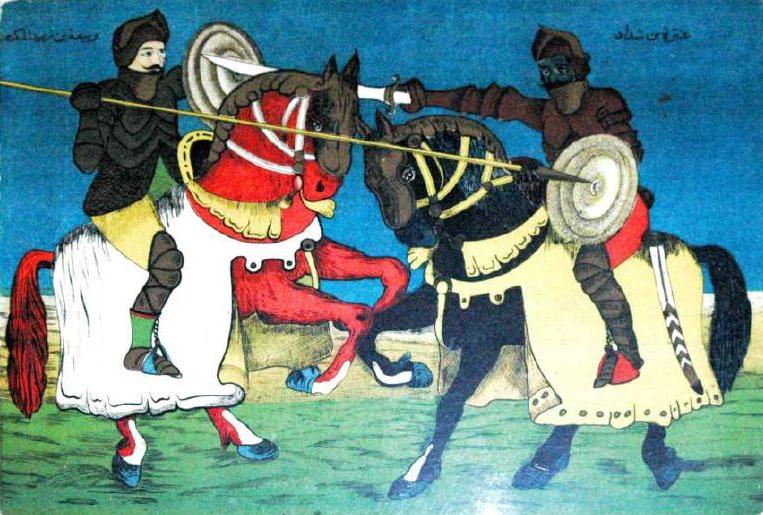
The story of Antar begins in 525 A.D. with the son of the King Of Arabia, whose name was Shedad. In search of adventure, Shedad went on a quest to conquer new and distant lands. In due time, he came upon a people whom he and his armies overthrew. Among the captives was a strikingly beautiful Black slave named, Zebiba.

Shedad fell in love with the Beautiful Black Zebiba and relinquished his birthright as the Son of King Zoeher in favor of a life of toil and struggle with the slave, Zebiba and her two sons. Shortly thereafter, Zebiba gave birth to another son by Shedad who was blessed with agility, a grand physique and the strength of ten men.

Even in his youth, the mighty Antar’s feats of strength and bravery made him famous as a warrior as well as a defender of women. He soon was elevated to a position of great esteem but as the son of a slave, was still considered unfit for the affections of the princess, ‘Ablah, with whom he had fallen hopelessly in love. One day Antar happened to bear witness to princess ‘Ablah (who also happened to be his cousin, she being the daughter of his father’s brother) getting her hair combed. He had never before seen her in such a vulnerable and exposed state, as she was always covered. Thus, his heart ignited into a flame of fire of love at her beauty and delicateness which could never be extinguished, regardless of the differences in their social statuses.

When his amorous intentions towards Princess ‘Ablah were made known, The Mighty Antar was demoted back to the position of a slave camel herder and lived in solitude, all the while harboring an unquenchable, burning passion for the beautiful ‘Ablah.

Eventually, King Zoehar’s Kingdom came under attack, but because of their jealousy of the mighty Antar’s strength and great power, the King and the chieftans refused to seek out the help of the mighty warrior and for his part, Antar, enveloped in the solitude of his unrequited love, did not offer.

Conditions worsened and the women were taken hostage including, ‘Ablah. After one particularly fatal battle for King Zoehar, he saw no other choice than to beseech Antar for his help in defeating their adversaries.

Antar acquiesced under the condition that should he be victorious, he would be given ‘Ablah’s hand in matrimony. The King and ‘Ablah’s father agreed. As to be expected, Antar defeated the opposing army and returned to his land and people a champion. However, Ibla’s father still was not too keen on the idea of his daughter marrying a slave. He double-crossed Antar and added the stipulation that in order for Antar to win his daughter’s hand in matrimony he must offer, as a dowry, 1,000 camels of  a certain breed that can only be found in faraway lands.

Antar did not balk at the challenge but set off in search of the steeds with love in his heart and determination in his mind. During his travels he happened to be taken hostage, tied up and jailed by a people who were being antagonized by a ferocious lion, the likes of which had never terrorized the land. Antar bid his captors to give him the chance to defeat the lion and they, having no other options granted him the opportunity.

Antar was a skilled lancer and his marker hit its target but the lion was too powerful to be killed instantaneously and continued to attack. Antar uprooted a small tree and proceeded to beat the lion with the tree, until it lay dead at his feet.

The King and the townspeople were so amazed at Antar’s feat of bravery and skill that they did not believe it until they saw the defeated corpse of the lion. As a reward, the King offered Antar precious jewels, treasures and the 1000 camels his uncle, required to marry his daughter, Antar’s beloved, ‘Ablah.

Soon after Antar and ‘Ablah were married and they lived happily ever after.

ANTAR

The Poem of Antar

Have the poets left in the garment a place for a patch to be patched by me; and did you know the abode of your beloved after reflection?

The vestige of the house, which did not speak, confounded thee, until it spoke by means of signs, like one deaf and dumb.

Verily, I kept my she-camel there long grumbling, with a yearning at the blackened stones, keeping and standing firm in their own places.

It is the abode of a friend, languishing in her glance, submissive in the embrace, pleasant of smile.

Oh house of ‘Ablah situated at Jiwaa, talk with me about those who resided in you. Good morning to you, O house of ‘Ablah, and be safe from ruin.

I halted my she-camel in that place; and it was as though she were a high palace; in order that I might perform the wont of the lingerer.

And ‘Ablah takes up her abode at Jiwaa; while our people went to Hazan, then to Mutathallam.

She took up her abode in the land of my enemies; so it became difficult for me to seek you, O daughter of Mahzam.

I was enamored of her unawares, at a time when I was killing her people, desiring her in marriage; but by your father’s life I swear, this was not the time for desiring.

And verily you have occupied in my heart the place of the honored loved one, so do not think otherwise than this, that you are my beloved.

And how may be the visiting of her; while her people have taken up their residence in the spring at ‘Unaizatain and our people at Ghailam?

I knew that you had intended departing, for, verily, your camels were bridled on a dark night.

Nothing caused me fear of her departure, except that the baggage camels of her people were eating the seeds of the Khimkhim tree throughout the country.

Amongst them were two and forty milk-giving camels, black as the wing-feathers of black crows.

When she captivates you with a mouth possessing sharp, and white teeth, sweet as to its place of kissing, delicious of taste.

As if she sees with the two eyes of a young, grown up gazelle from the deer.

It was as though the musk bag of a merchant in his case of perfumes preceded her teeth toward you from her mouth.

Or as if it is an old wine-skin, from Azri’at, preserved long, such as the kings of Rome preserve;

Or her mouth is as an ungrazed meadow, whose herbage the rain has guaranteed, in which there is but little dung; and which is not marked with the feet of animals.

The first pure showers of every rain-cloud rained upon it, and left every puddle in it bright and round like a dirham;

Sprinkling and pouring; so that the water flows upon it every evening, and is not cut off from it.

The fly enjoyed yet alone, and so it did not cease humming, as is the act of the singing drunkard;

Humming, while he rubs one foreleg against the other, as the striking on the flint of one, bent on the flint, and cut off as to his palm.

She passes her evenings and her mornings on the surface of a well-stuffed couch, while I pass my nights on the back of a bridled black horse.

And my couch is a saddle upon a horse big-boned in the leg, big in his flanks, great of girth.

Would a Shadanian she-camel cause me to arrive at her abode, who is cursed with an udder scanty of milk and cut off?

After traveling all night, she is lashing her sides with her tail, and is strutting proudly, and she breaks up the mounds of earth she passes over with her foot with its sole, treading hard.

As if I in the evening am breaking the mounds of earth by means of an ostrich, very small as to the distance between its two feet, and earless.

The young ostriches flock toward him, as the herds of Yamanian camels flock to a barbarous, unintelligible speaker.

They follow the crest of his head, as though it was a howdah on a large litter, tented for them.

He is small headed, who returns constantly to look after his eggs at Zil-‘Ushairah; he is like a slave, with a long fur cloak and without ears.

She drank of the water of Duhruzain and then turned away, being disgusted, from the pools of stagnant water.

And she swerves away with her right side from the fear of one, whistling in the evening, a big, ugly-headed one;

From the fear of a cat, led at her side, every time she turned toward him, in anger, he met her with both claws and mouth.

She knelt down at the edge of the pool of Rada’, and groaned as though she had knelt on a reed, broken, and emitting a cracking noise.

And the sweat on the back was as though it were oil or thick pitch, with which fire is lighted round the sides of a retort.

Her places of flexure were wetted with it and she lavishly poured of it, on a spreading forelock, short and well-bred.

The length of the journey left her a strong, well-built body, like a high palace, built with cement, and rising high; and feet like the supports of a firmly pitched tent.

And surely I recollected you, even when the lances were drinking my blood, and bright swords of Indian make were dripping with my blood.

I wished to kiss the swords, for verily they shone as bright as the flash of the foretooth of your smiling mouth.

If you lower your veil over yourself in front of me, of what use will it be? for, verily, I am expert in capturing the mailed horseman.

Praise me for the qualities which you know I possess, for, verily, when I am not ill-treated, I am gentle to associate with.

And if I am ill-treated, then, verily, my tyranny is severe, very bitter is the taste of it, as the taste of the colocynth.

And, verily, I have drunk wine after the midday heats have subsided, buying it with the bright stamped coin.

From a glass, yellow with the lines of the glass-cutter on it, which was accompanied by a white-stoppered bottle on the left-hand side.

And when I have drunk, verily, I am the squanderer of my property, and my honor is great, and is not sullied.

And when I have become sober, I do not diminish in my generosity, and as you know, so are my qualities and my liberality.

And many a husband of a beautiful woman, I have left prostrate on the ground, with his shoulders hissing like the side of the mouth of one with a split lip.

My two hands preceded him with a hasty blow, striking him before he could strike me; and with the drops of blood from a penetrating stroke, red like the color of Brazil wood.

Why did you not ask the horsemen, O daughter Malik! if you were ignorant, concerning what you did not know about my condition,

At a time when I never ceased to be in the saddle of a long striding, wounded, sturdy horse, against whom the warriors came in succession.

At one time he is detached to charge the enemy with the lance, and at another he joins the large host with their bows tightly strung.

He who was present in the battle will inform you that verily I rush into battle, but I abstain at the time of taking the booty.

I see spoils, which, if I want I would win; but my bashfulness and my magnanimity hold me back from them.

And many a fully armed one, whom the warriors shunned fighting with, neither a hastener in flight, nor a surrenderer;

My hands were generous to him by a quick point with a straightened spear, strong in the joints;

Inflicting a wound wide of its two sides, the sound of the flow of blood from it leads at night the prowling wolves, burning with hunger.

I rent his vesture with a rigid spear, for the noble one is not forbidden to the spears.

Then I left him a prey for the wild beasts, who seize him, and gnaw the beauty of his fingers and wrist.

And many a long, closely woven coat of mail, I have split open the links of it, with a sword, off one defending his rights, and renowned for bravery.

Whose hands are ready with gambling arrows when it is winter, a tearer-down of the signs of the wine-sellers, and one reproached for his extravagance.

When he saw that I had descended from my horse and was intending killing him, he showed his teeth, but without smiling.

My meeting with him was when the day spread out, and he was as if his fingers and his head were dyed with indigo.

I pierced him with my spear, and then I set upon him with my Indian sword pure of steel, and keen.

A warrior, so stately in size as if his clothes were on a high tree: soft leather shoes are worn by him and he is not twinned.

Oh, how wonderful is the beauty of the doe of the hunt, to whom is she lawful? To me she is unlawful; would to God that she was not unlawful.

So, I sent my female slave, and said to her, “Go, find out news of her and inform me.”

She said, “I saw carelessness on the part of the enemies, and that the doe is possible to him who is shooting.”

And it was as though she looked toward me with the neck of a doe, a fawn of the gazelles, pure and with a white upper lip.

I am informed that ‘Amru is unthankful for my kindness while ingratitude is a cause of evil to the soul of the giver.

And, verily, I remember the advice of my uncle, in the battle, when the two lips quiver from off the white teeth of the mouth,

In the thick of the battle, of which the warriors do not complain of the rigors, except with an unintelligible noise.

When they (i.e., my people) defended themselves with me against the spears of the enemy, I did not refrain from them (i.e., the spears) through cowardice, but the place of my advance had become too strait.

When I heard the cry of Murrah rise, and saw the two sons of Rabi’ah in the thick dust,

While the tribe of Muhallam were struggling under their banners, and death was under the banners of the tribe of Mulhallam {sic.},

I made sure that at the time of their encounter there would be a blow, which would make the heads fly from the bodies, as the bird flies from off her young ones sitting close.

When I saw the people, while their mass advanced, excite one another to fight, I turned against them without being reproached for any want of bravery.

They were calling ‘Antarah, while the spears were as though they were well-ropes in the breast of Adham.

They were calling ‘Antarah, while the swords were as though they were the flash of lightnings in a dark cloud.

They were calling ‘Antarah, while the arrows were flying, as though they were a flight of locusts, hovering above watering places.

They were calling ” O ‘Antarah,” while the coats of mail shone with close rings, shining as though they were the eyeballs of frogs floating in a wavy pond.

I did not cease charging them, (the enemy,) with the prominent part of his (horse’s) throat and breast, until he became covered with a shirt of blood.

Then he turned on account of the falling of the spears on his breast, and complained to me with tears and whinnyings.

If he had known what conversation was, he would have complained with words, and verily he would have, had he known speech, talked with me.

And verily the speech of the horsemen, “Woe to you, ‘Antarah, advance, and attack the enemy,” cured my soul and removed its sickness.

While the horses sternly frowning were charging over the soft soil, being partly the long-bodied mares, and partly the long-bodied, well-bred horses.

My riding-camels are tractable, they go wherever I wish; while my intellect is my helper, and I drive it forward with a firm order.

Verily, it lay beyond my power that I should visit you; so, know what you have known, and some of what you have not known.

The lances of the tribe of Bagheez intercepted you and the perpetrators of the war set aside those who did not perpetrate it.

And, verily, I turned the horse for the attack, while his neck was bleeding, until the horses began to shun me.

And verily I feared that I should die, while there has not yet been a turn for war against the two sons of Zamzam;

The two revilers of my honor, while I did not revile them, and the threateners of my blood, when I did not see them.

There is no wonder should they do so, for I left their father a prey for the wild beasts and every large old vulture.
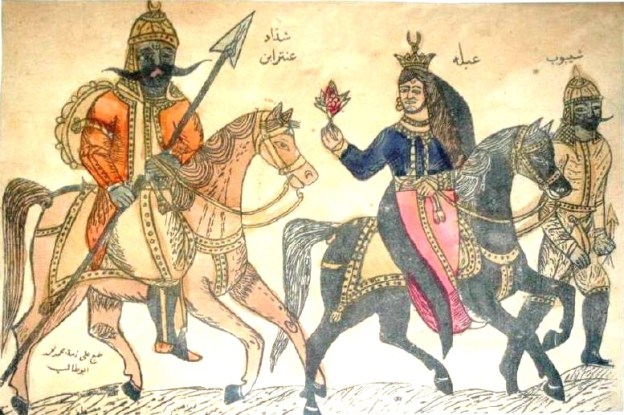
Antarah_ibn_Shaddad__Abla

My sin against Ablah is beyond remission;
Became obvious when the morning of life
Lent streaks of its white shafts
To my hair, turning it gray.
My own Ablah pierced my heart with arrows,
Shot from her white-corona, black-iris eyes;
Accurately hitting the mark!
How amazing! Arrows projected from eyelids
With no string or bow, ever scoring, never missing
I have kept faith with my fellow tribesmen
Protected their honor
Often curbing my passion
For their playful and modest girls.
Such mild and gentle beauties!
Make tender branches envious
Of their graceful swaying, elegant swinging.

O dear Abode (of the Beloved),
Should the clouds withhold their rain from you,
Let my tears then pour down on you instead
O how pleasant the times I spent
In the land of Sharibba,
Enjoying myself in the company of
My friends and delicate women.
When the twig of my youth was soft and pliable,
How I amused myself,
Admiring its blossoms and streaks.
Everyday, the breeze of Sharibba
Comes to me laden with the sweet scent
Of fragrant flowers unfolding at dawn

Each (maiden), like a straight leafy branch;
A lover can only feast his eyes
On such beauty, (but not touch.)
I am ever anxious to see Ablah;
That is why I so often stop by her camp,
Water my camels then depart.
After being close to her, I can never content myself
With only a word about her,
Now she is far away

She will always remain my dearly beloved,
Even if she should betray my trust, forsake me.
My love for her will remain unchanged, undiminished,
Nor will I ever stop thinking of her.
Secretly and openly,
I bemoan my separation from her;
With such intensity of feeling
That softens the rocks
O Abla stay safe and be happy in the Sand Valley
Away from enemies; fear not even if frightened.
Know that your dwelling is protected
By lions with mighty swords
That smash iron helmets, slice thick armors.

How great are my folks Bani Abs!
They have reached the pinnacle of honor;
Attained the height of prestige
When they saw my horse
Charge unrestrained, beneath thick clouds of dust
They thought it was bringing me nigh to doom.
Then they quickly trod on my heels,
Knowing that death is an unavoidable arrow, deflecting never.
I plunged headlong into the dust-covered battleground,
Atop my pitch black charger;
Upon return, his body was blood covered,
With human remains to its skin attached

I endeavored to be fair to my opponent,
However, he wronged me,
Resorting to mean, devious means.
Finally, my sword dealt him a fair blow.
Should others taunt me
On account of the blackness of my skin,
Let them keep in mind
That precious pearls are in shells contained

Antarah (Antar) ibn Shebab
Antarah_fighting

O, dwellings tell me; where your inhabitants are going?

And to where their cameleers proceed along or halting?
Yesterday thy place showed sociable deer played joyfully.
But today the craws caw instead of them gloomily.
O, Ablah’s dwelling where Ablah’s tribe is camped.
After the camels had conveyed them far away and vanished.
All pigeons cooed after the people had departed.
As well as the Ben-oil tree due to its misery had cried.
The essence of each homeland is the souls of its inhabitants.
If they went away, the bodies will cry them in variance.
O, fellow ask Ablah’s verdured locations on the wilderness display.
Be witty if you ask! Does the place have any tongue to reply?
O, Ablah the reunion had lasted several delicious nights
Followed by the darken days which overcast the shining lights.
If only the dwelling have the choice to answer!
Where are people settled later?
O, bird that slept its night crying about its fellows was ‘grieved
‘Did not know what the matter is! Only it is bewildered.
If you were as me, no longer would you pride about your colourful shape.
Yet the branches have not shaken to you otherwise you cannot leap.
Hardly you can find lover whose heart is peaceful.
Since he suffers the ardent love, his heart is sorrowful.
O, bird borrows me your wing and I give you my tears instead.
Even if I die, the tears still shed without stopping indeed.
Therefore, I could fly to Abla asking about her place
If the flying were possible, I would prove this case

Antar tunisia

Behind their veils glimmer apparently
As if the sharp blade of the sword stabbing my heart fiercely
If they are unsheathed, the brave man becomes coward readily
And his eyeholes turn ulcerated replete with tears shed heavily
I wish God would quench my uncle the cup of death bitterly
His hands turn palsied after his fingers were amputated totally
As he sends me to the death, the escape is hardly
He promises me in what I am desirous of eventually
Abla has said farewell to me when I intended the departure
She was some sure that she would not see me on future?
She wept and said! How do you do if you are naked?
What will happen then if you are on the wide desert settled
By your honour, I did not try any comfort is accessible
My passion toward thee love on all my life is unchangeable
You cousin be sure of my sincere cordiality
You lover be soft on pleasure without anxiety
I said to her; hereinafter should I travel either alive or dead
Even if the sharp swords impede my way, I shall go ahead
We were born for the sake of this love formerly
Therefore, I think this love will not die since it is eternally
O, you the optimistic place, really! I come back alive
Then I see on its both sides the annual flowers revive
I wish my eye saw both hillocks and the adjacent lively location
However, it can see the rest of people in that verdured situation
Then we live along with on our favourable places do not separated
In those certain verdured sides, we would be happy and delighted
By God, thou the breeze with the oily ben odor are scented
Reach Abla and inform her about the places had I reached
O, lightning, inform her on this morn my greeting
As well as any place had I rest there and my dwelling
O, chanting birds if I die mourn nearby my tomb right after
Lift my soul with thy wings to be in heaven settled forever
Weep and mourn about who dies aggrievedly without reason
Do not gain only the lover’s torture and the pain of separation
And you horses cry about your horseman abundantly.
This who throws oneself into battlefield’s dusts bravely
You should be acquainted ‘soul’ to the humiliation suffering thy passion
You may be tied with heavy bonds of a familiar slavery fashion
Never will I cry if my fate has come manifestly
May be I mislead then shed tears spontaneously
It is not pride that I state my bravery or severity on each assembly
While my fame everywhere is celebrated widely
By platonic love, do not blame me and stop thy talkativeness
Blame never has benefit or any dependable seriousness?
How can I endure the unbearable patience of this lover.
Since the passionate love enkindles my ribs moreover