
MUSLIM
DAILY PRAYERS
compiled
under the guidance of
Mr. Elijah Muhammad
Messenger of Allah
to the Lost-found Nation of Islam
in North America
for the use of members
of MUHAMMAD’S
TEMPLES OF ISLAM
throughout the United States of America
(1)
In the Name of Allah, the Beneficent,
the Merciful
As-Salaamu ‘ Alaikum
FOREWORD
Here, my beloved people who Believe, is the Book of Muslim Daily Prayers I had promised some time ago to make available to you.
Allah, your God and mine, says in the Holy Qur’an Sharrieff (29:45): “Surely prayer keeps (one) away from indecency and evil; and certainly the remembrance of Allah is the greatest (force that restrains evil.)”
The knowledge and practice of these prayers will earn you great reward with Allah and bring about great spiritual advancement in you.
(2)

THE HONORABLE ELIJAH MUHAMMAD
(3)
These prayers, of course, are only a part of your duties as Muslims and as Believers in Allah and His Messenger Muhammad. Keep up your prayers, but be mindful of your duties as well. Be completely RIGHTEOUS.
At present it is sufficient that you learn these prayers as we have printed them here. Some day in the near future, however, you will learn them in your own language and that of your Righteous foreparents – Arabic.
May Allah bless you and keep you on the Right Path.
ELIJAH MUHAMMAD

(4)
Muslims’ Oft-Repeated Prayer
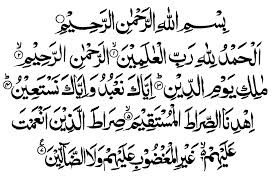
The “Fatiha” Printed in Arabic
(5)
The Muslim’s oft-repeated prayer is the Fatiha.
The Fatiha (“Opening”) is the first Chapter of the Holy Qur’an and constitutes the Muslim’s prayer for guidance.
It is indeed the sublimest of all prayers in any religion. It speaks of Allah’s four chief attributes – providence, beneficence, mercy and requital – and exhorts the believers in Him to seek constantly his guidance and blessings.
* * * *
The Fatiha reads thus:
“In the Name of Allah, the Beneficent, the Merciful. All Praise is due to Allah, the Lord of the Worlds; the Beneficent, the Merciful; Master of the Day of Requital. Thee do we serve, and Thee do we beseech for help.
(6)
Guide us on the Right Path – the path of those upon whom Thou has bestowed favors, not of those upon whom Thy wrath is brought down, nor of those who go astray.
_________________________________________________________________________________________
Object of Muslim’s Prayer
The object of Muslim’s prayer is the purification of heart, which is necessary for spiritual advancement.
Benefit of prayer
Allah promises many blessings to you if you turn to Him in prayer. Nations are no doubt destroyed when they indulge in evil inordinately, and they prosper only so long as their good qualities preponderate.
(7)
______________________________________________________________________________________________
Daily Prayers
The Muslims’ daily prayers are five in number. These are:
1. THE DAWN or EARLY MORNING prayer (known in Arabic as Fajr ), which is performed at daybreak and before sunrise.
2. THE EARLY AFTERNOON prayer (known in Arabic as Zuhr), which is performed shortly after the noon hour.
3. THE LATE AFTERNOON prayer (known in Arabic as ‘Asr), which is performed around four o’ clock in the afternoon, or close to two hours before sunset time.
4. THE SUNSET or EVENING prayer (known in Arabic as Maghrib), which is performed just after the sunset.
(8)
5. THE LATE EVENING or NIGHTFALL prayer (known in Arabic as ‘Isha), which is performed nearly two hours after the sunset time or before retiring.
It says in the Holy Qur’an Sharrieff (4:103), “Prayer indeed has been enjoined on the believers at fixed times.” In other words, it is essential that each prayer be performed at the appointed hour.
The exact time for each prayer will, of course, differ from coast to coast, especially when “Daylight Savings Time” is in force. To be sure of the precise hours, therefore, consult your Temple Minister.
Preparation for Prayers
The Muslims’ daily prayers are not to be taken for ordinary rituals. You must perform your prayers with utmost sincerity and
(9)
seriousness, because they represent your Communion with your Maker, Almighty Allah.
To prepare yourself for the wonderful experience known as Muslim’s prayer, and to bring yourself in the right spiritual mood, it is required that you perform an “Ablution,” which is done by:
Washing the hands to the wrists;
Rinsing the mouth three times;
Cleaning the inside of the nose with water three times;
Washing the face three times;
Washing the arms to the elbows three times (The right arm should be washed first);
Wiping over the head with wet hands;
Wiping the ears with wet fingers;
Wiping around the neck with wet hands: and
(10)
Washing the feet (the right one first) to the ankles.
In case you take a bath before you wish to perform any of the prayers, the “Ablution” as described above is not necessary.
On the other hand, in certain cases, which only your Minister (or, in the case of Sisters, their Teacher at the Temple) can best explain, mere “Ablution” isn’t sufficient and a complete bath is required before the prayer can be performed.
Significance of “Ablution”
Each part of the Ablution requirement has some significance. For instance, the Muslim washes his hands to “get rid of any evil” they might have committed. This also signifies that the Muslim thus asks Allah to wash his hands in the Spirit of Forgiveness.
(11)
“Adhan,” or the Call to Prayer
If you intend to perform your prayers in a congregation (group of three or more), a Call (adhan) should then be made to the faithful. This consists of the following: (Only one person makes the Call.)
Stand erect on the prayer rug or sheet, facing the Holy City of Mecca (East), with your hands upright touching the ears, and recite:
Allah is the Greatest (Four times)
I bear witness that there is none worshippable other than Allah (Twice)
I bear witness that Muhammad is Allah’s Messenger (Twice)
Come to Prayer (Twice)
Come to Success (Twice)
Allah is the Greatest (Twice)
(12)
There is none worshippable but Allah (Once)
The call to the Dawn prayer includes an additional line, which is uttered (twice) after the expression “Come to Success.” It says: Prayer is better (for you) than sleep.
Prayer to be Recited After Hearing “Adhan”
“O Allah! The Lord of this perfect call, and of the prayer to be offered! Bestow on Muhammad the means, the greatness, and high dignity, and elevate him in the most exalted place which Thou has promised him. Verily Thou never breakest Thy promise.”
(13)
Obligatory and the Traditional Prayers
Each prayer consists of two parts: one is obligatory (called in Arabic Fard), the other traditional (called in Arabic Sunnah); and each comprises a different number of “steps,” known as a rak’ahs.
The chart on the opposite page gives the necessary information pertaining to the specifications of each daily prayer.
Description of a “Step” (Rak’ah)
A “step” (Rak’ah) consists of the standing, bending, rising, and prostrating positions. After every two “steps” (rak’ahs) there is a sitting position.
(14)
Obligatory and Traditional Prayers
| Name of Prayer: | Obligatory part: No. of “steps” (or rak’ahs) |
Traditional part: No. of “steps” (or rak’ahs) |
| DAWN | 2 | 2 |
| EARLY AFTERNOON | 4 | 4 |
| LATE AFTERNOON | 4 | 4 |
| SUNSET | 3 | 2 |
| LATE EVENING | 4 | 3 |
The Friday Congregational Prayer: A special Congregational Prayer, preceded by a Sermon, is held each Friday afternoon, replacing the regular EARLY AFTERNOON prayer for that day, wherever facilities for such are available or a mosque exists.
(15)
Procedure of Prayer
After you have performed your “ablution,” step on your prayer rug (or a clean folded sheet or large-size towel) and stand erect, facing in the direction of the Holy City of Mecca (which is directly East from most points in the U.S.A.)
Then recite: “Surely I have turned myself being upright to Him Who originated the Heavens and the Earth and I am not from among the polytheists.”
Then say: ” I hereby resolve to perform two ( three, or four, whatever the case may be) ‘steps’ of the Obligatory (or Traditional) part of the (name of) Prayer.” This is followed by the raising of hands, accompanied by the utterance of the words “Allah is the Greatest,” after which you rest your hands, one over the other, upon your chest.
(16)
Then recite the following:
“Glory and Praise to Thee, O Allah! And Blessed is Thy name, and Exalted is Thy majesty, and there is none worshippable but Thee.”
“I take refuge in Allah against the accursed Satan.”
“In the name of Allah, the Beneficent, the Most Merciful.
“All Praise is due to Allah, the Lord of the Worlds; the Beneficent, The Most Merciful; and Master of the Day of Requital. Thee do we serve and Thee do we beseech for help. Guide us on the right path—the path of those upon whom Thou has bestowed favors, not of those upon whom Thy wrath is brought down, nor of those who go astray. Amen.”
(17)
The next recitation comprises a chapter–any chapter–of the Holy Qur’an. Below is the translation of one, the 112th:
“Say that Allah is one. He is All-independent. He begetteth not, nor was He begotten. And there is none comparable unto Him.”
Following this, utter once again “Allah is the Greatest.” Then go into the bending position,
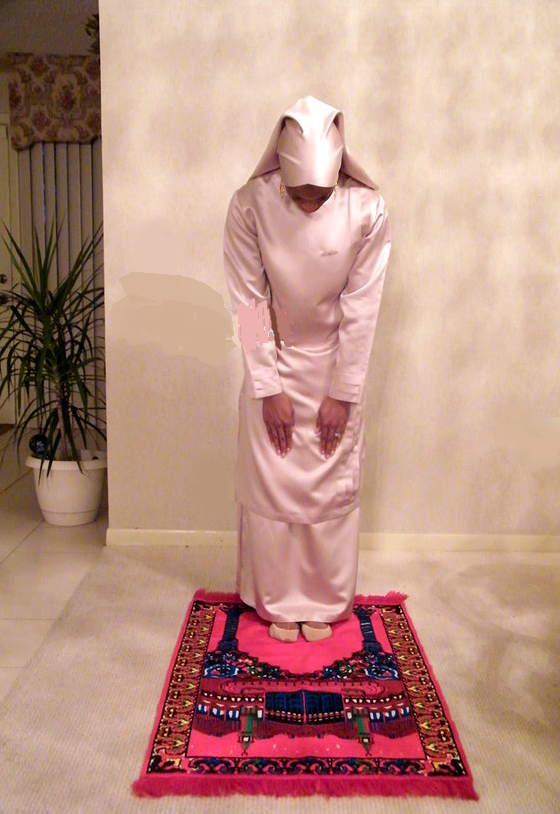
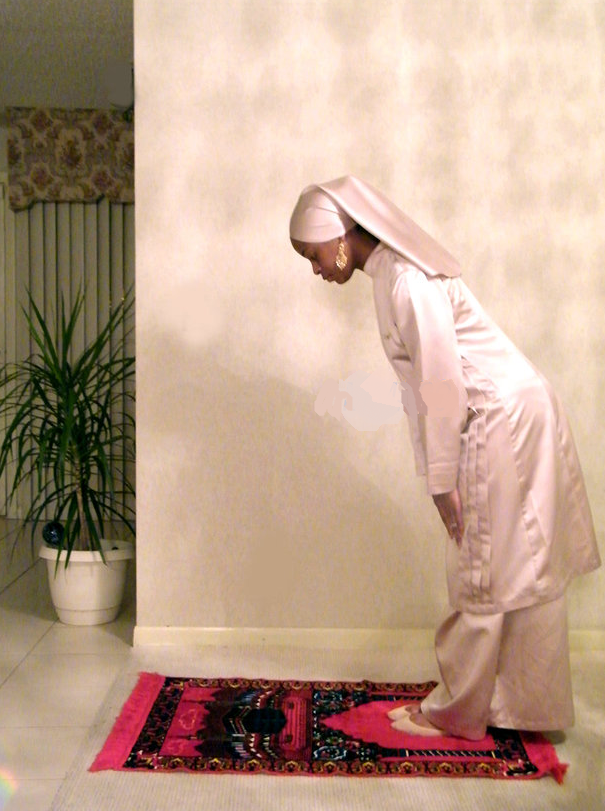
and say three times “Glory to my Lord, the Great.” Then arise, saying “Surely Allah answers him who praises Him. Our Lord! Thine is the praise.”
Now again say “Allah is the Greatest,” after which comes the prostration.
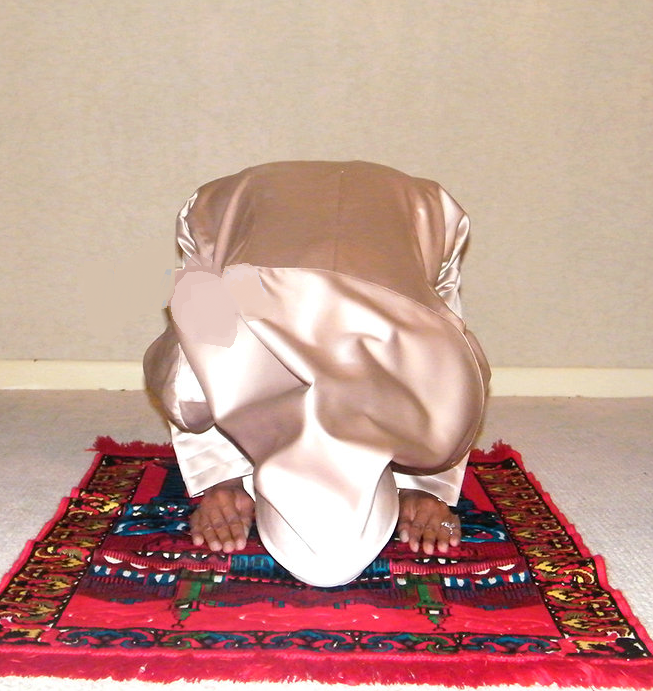
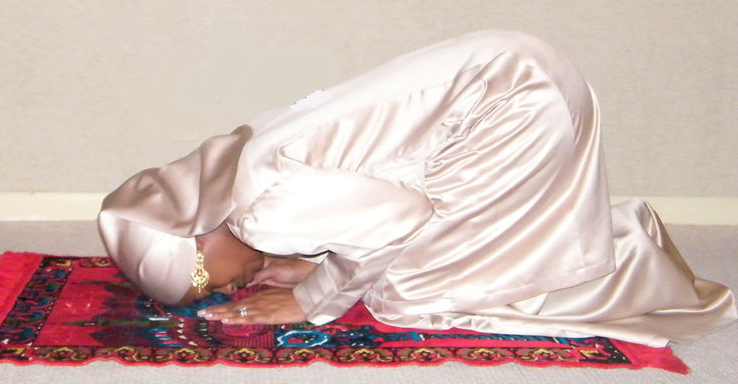
While in this position, say three times “Glory to my Lord, the Most High.” Then arise,

saying “Allah is the Greatest,” and repeat the prostration. This completes one “step” (rak’ah.)
(18)
The second and all subsequent “steps” (rak’ahs) are performed by repeating this procedure, except that after every two “steps” (rak’ahs) there is a additional position (sitting) to be observed. The following recitation for this position is as follows:
“Greetings are for Allah, as also prayers and good deeds. Peace be upon you, O Messenger, and the mercy of Allah. Peace be upon us and the righteous servants of Allah. I bear witness that there is none worshippable but Allah, and that Muhammad is His Servant and Messenger. O Allah! Bless Muhammad and his followers, as Thou blessed Abraham and his followers. And grant Thy favors to Muhammad and his followers, as Thou granted favors to Abraham and his followers. In the Worlds, indeed, only Thou are Praiseworthy and Magnified.”
(19)
“O Allah! Help me to be steadfast in prayer and also my children. O our Lord! Accept my prayer. O my nourisher, forgive me and forgive my parents and all the Believers when their judgement is held.”
The prayer ends by turning the head, first to right and then to the left, and saying “Peace and mercy of Allah unto you!”
(20)
Limitation and Exceptions
There are certain circumstances and conditions under which a prayer is unacceptable to Allah. For information about these please consult your Minister (or the Sisters’ Teacher).
Looking around, moving or talking during the prayer is strictly forbidden. Even slight movement of the hands is not tolerated except when such motion is absolutely necessary.
Muslim women need not perform any of the prayers when in menstruation or while in child-bed.
The clothes worn when praying must be clean in every sense of the word.
(21)
Holy Quran on Prayer
“So bear patiently what they say, and celebrate the praise of the Lord before the rising of the sun and before its setting, and glorify (Him) during the hours of the night and parts of the day, that thou mayest be well pleased.” (THE HOLY QURAN, 20:30)
“Keep up prayer from the declining of the sun till the darkness of the night, and the recital of the Quran. Surely the recital of the Quran at dawn is witnessed.” (THE HOLY QURAN, 17:78)
“Say: Call on Allah or call on the Beneficent. By whatever name you call on Him, He has the best names. And utter not thy prayer loudly nor be silent in it, and seek a way between these.”
(HOLY QUR’AN, 17:116)
(22)
A Comment
“Recite that which has been revealed to thee of the book and keep up prayer. Surely prayer keeps (one) away from indecency and evil; and certainly the remembrance of Allah is the greatest (force). And Allah knows what you do.” (THE HOLY QUR’AN, 29:45)
“The verse quoted above invites the followers of all religions to accept the Holy Qur’an on account of its purifying effect upon life, as the previous scriptures had ceased to effect deliverance from the bondage of sin, which is the real object of the revelation. The verse also lays down the right principle for getting rid of the bondage of sin in the words the remembrance of Allah is the greatest, i.e., the most powerful and effective restraint upon sin. It is a living belief in the Divine
(23)
power, knowledge and goodness that restrains man from walking in the ways of His displeasure. A sure and certain knowledge that every evil action leads to an evil consequence, that there is a Supreme Being, Who knows what is hid from human eyes and Whose moral law is effective where the moral force of society fails, and that He is the source of all goodness and it is through goodness that man can have communion with Him, are the only effective restraints upon evil.”
–Maulana Muhammad Ali, in his “Translation of the Holy Qur’an”
(24)

 Homemaking For The Black Muslim Woman Journal ™
AS-SALAAM-ALAIKUM IAM NOT TRYING TO ATTACK YOU SISTER BUT I LIKE TO SEE OR READ WHERE THE MOST HONORABLE ELIJAH MUHAMMAD (PEACE BE UPON HIM) SAID FOR US TO PRAY ON OUR KNEES ,,, I WAS TAUGHT TO STAND AND PRAY ,I SAW THE LAST MESSENGER TEACHER PRAYER, HE STOOD AND PRAYED …
https://homemakingfortheblackwoman.wordpress.com/2014/03/25/knowledge-of-prayer/
As Salaam Alaikum, The Most Hon. Elijah Muhammad, did not have a problem with praying on our knees and performing all the positions of Salat. If so, He would not have issued the above Muslim Daily Book wherein he mentions performing every position of the prayer. The standing alone position is which The Most Hon. Elijah Muhammad, is standing performing a prayer (I am familiar with the photo), it is Him making a short prayer or Dua’ called in Islam. We do both Dua’s and salat, as taught by The Most Hon. Elijah Muhammad…..I pray this answers your question.